

Every article I've read about teaching kids to cook age appropriate tasks starts with something like "ages 2-3: stirring, pouring, tearing lettuce." Which is technically accurate but leaves out the part where your toddler tears one piece of lettuce, eats it, spits it out, then asks for strawberries. That's where we actually live.
What Cooking Together Looks Like Right Now
My daughter stands on her step stool at the counter and I hand her things. That's it. That's the whole curriculum.
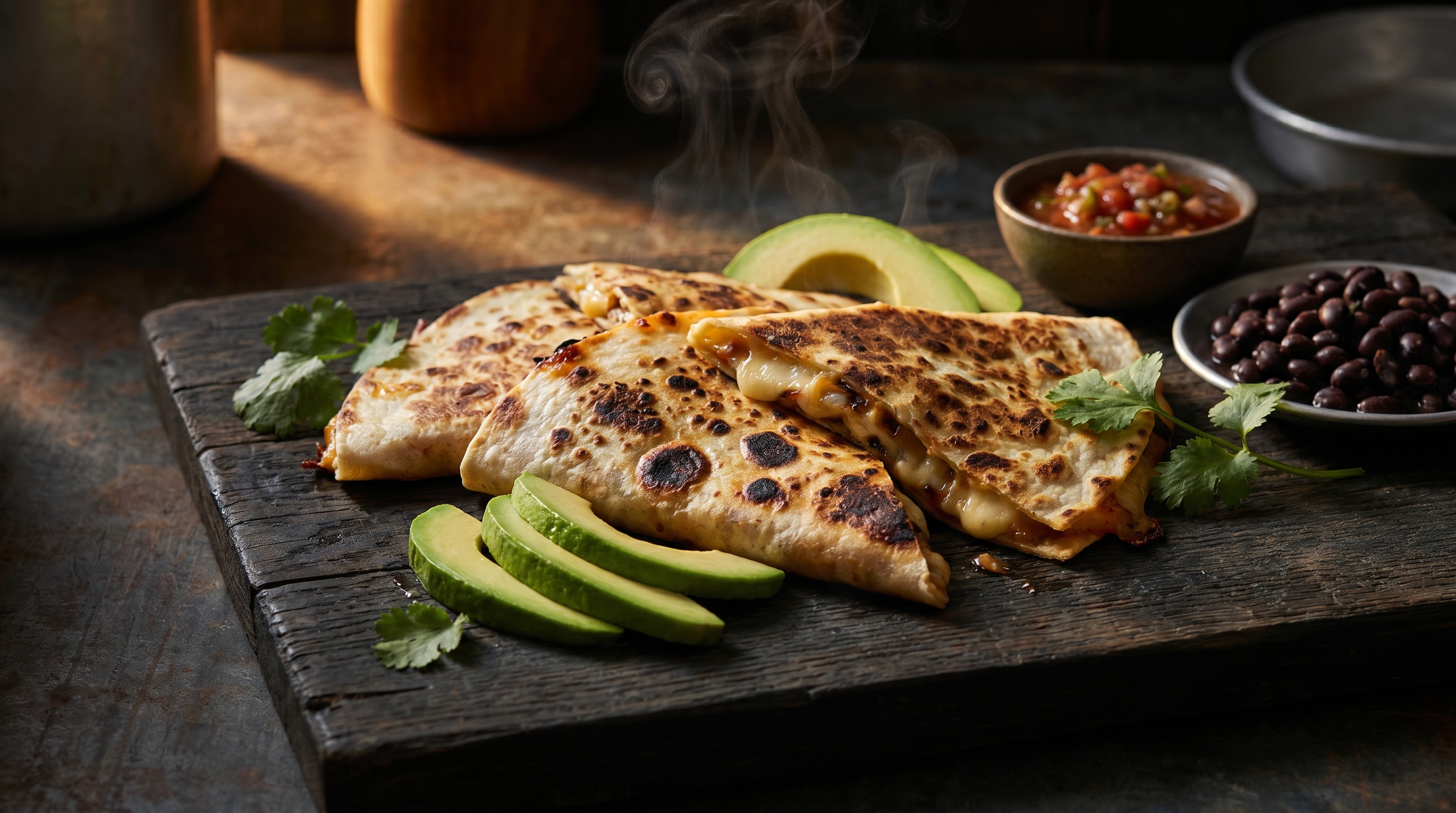
The other evening I was making quesadillas because the kitchen was too hot for anything ambitious and the sun was still flooding through the window at what felt like an unreasonable hour. She wanted up. She always wants up now. So I pulled the stool over and gave her a job: put the cheese on the tortilla.
She put three shreds on. Then she ate a fistful. Then she placed one single shred very carefully in the exact center, like she was performing surgery. The whole process took about four minutes for what would normally take me ten seconds.
It was the best part of my day.
The Slowness Is the Point
I think I expected "cooking with my daughter" to look like a thing we do together. Efficient. Cute. Photographable. Instead it looks like me doing a task at one-tenth speed while narrating everything in a voice I don't fully recognize. "Now we fold it. See? Fold. Like a blanket for the cheese."
She doesn't care about the quesadilla. She cares that I'm standing next to her, that I gave her something to hold, that I'm not looking at my phone. The food is incidental. The proximity is everything.
My husband wandered in halfway through and asked if he could help. She told him no. Her kitchen now, apparently.
What I'm Not Doing
I'm not following a Montessori cooking progression chart. I'm not buying tiny whisks from Instagram ads. I'm not documenting it for anyone. Some nights she's interested and some nights she'd rather stack blocks in the living room while I cook alone, and both of those are fine.
The pressure to make every moment educational is real and I'm choosing to ignore it. She's two. She's learning that the kitchen is a place where someone who loves her makes things. That food comes from somewhere, involves touching and smelling and sometimes waiting. That's enough for now.
The Part Nobody Writes About
There's a particular kind of loneliness that comes with cooking dinner every night. The repetition, the invisibility of it. Nobody's watching you dice an onion on a random evening in June. Nobody claps.
But she watches now. She sees me. She sees the butter hit the pan and hears the sizzle and says "hot" with big serious eyes. She's learning the sounds of someone taking care of her.
I don't know what she'll remember from this age. Probably nothing specific. But I think the feeling accumulates somewhere. The warmth, the smell, the standing together at the counter while the light stretches long across the floor.
She ate half the quesadilla and asked for strawberries. Of course she did.
I cut them up and we sat on the back step in the fading heat, and I thought about how my own mother used to let me "help" by handing me a wooden spoon and a pot with nothing in it. I don't remember what she cooked. I remember being next to her.